
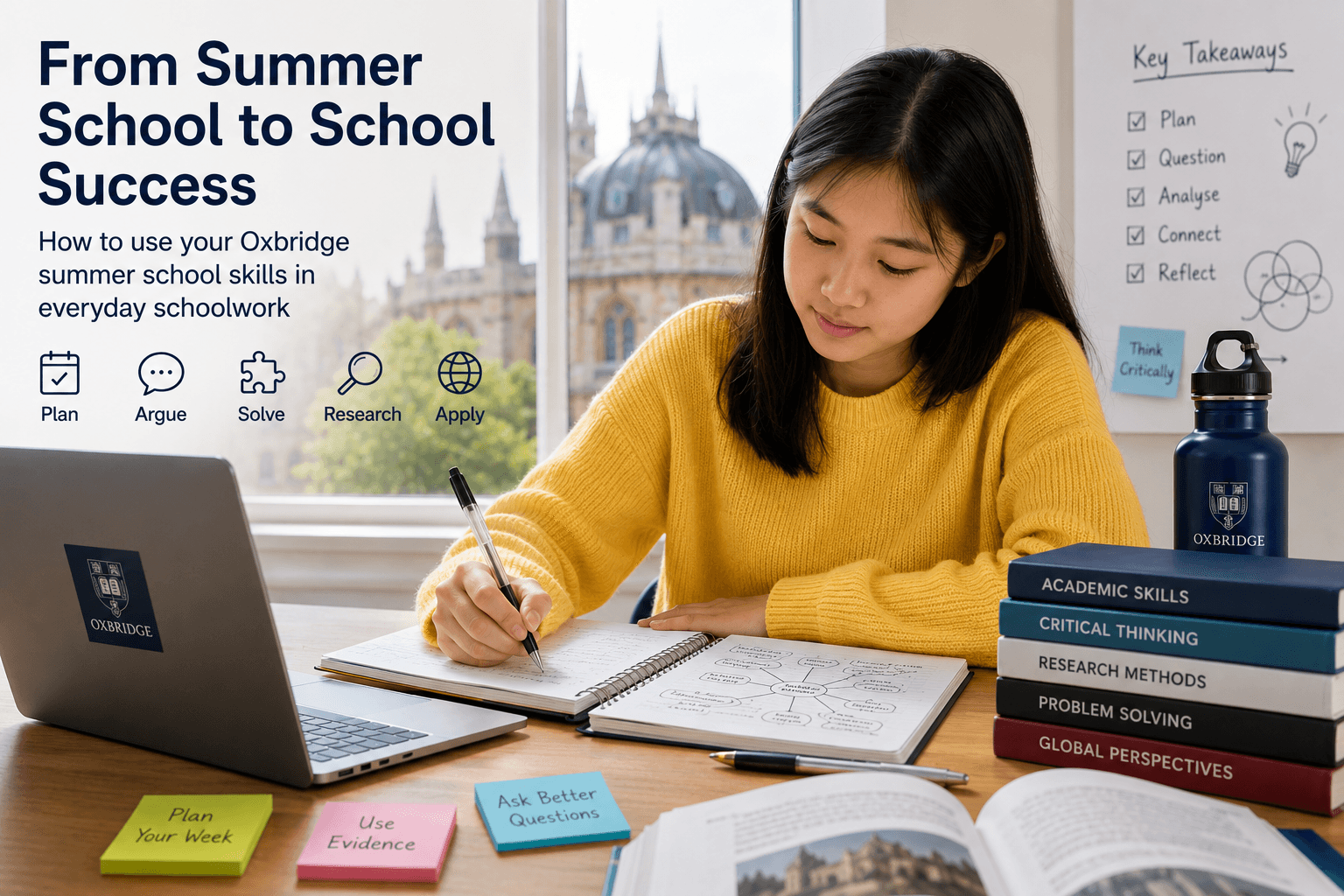
Turning Oxbridge Summer School Learning into School-Year Success
An Oxbridge summer school can expose teenagers to new ways of thinking, studying and solving problems. The most useful part of that experience is not necessarily a particular topic, but the academic habits they develop while working in a more intensive and independent environment.
Those habits can be carried straight back into ordinary schoolwork. From planning revision more effectively to building stronger arguments, testing evidence and approaching unfamiliar problems with more confidence, the skills developed on summer programmes can continue to be useful long after the course ends.
Here are some of the ways those skills can translate into everyday schoolwork, with examples from specific summer school courses and the skills they are designed to develop.
Plan and Organise Work More Effectively
At a Glance
Course: Study Skills · Provider: ISSFT · Ages: 13–18
The Study Skills course focuses on academic techniques such as time management and preparation for qualifications including GCSE, IB and SAT.
How to use it back at school
The most useful takeaway is to choose one or two planning techniques from the course and make them part of the school-week routine.
That might mean breaking larger assignments into manageable stages, starting revision earlier, organising notes more clearly or setting priorities at the beginning of each week.
Used consistently, these habits can make workloads feel more manageable and reduce the need for last-minute revision or rushed assignments.
Build Stronger Arguments in Essays and Discussions
At a Glance
Course: Experience Debate & Public Speaking Academy · Provider: Oxford Scholastica Academy · Ages: 13–15 and 16–18
The programme focuses on public speaking, debate, confidence and persuasive communication.
How to use it back at school
The most useful takeaway is to apply the same argument-building techniques to essays, presentations and classroom discussion.
That might mean making a clear point, supporting it with evidence, considering an opposing view and explaining why one argument is more convincing than another.
Used consistently, these habits can help students express ideas more clearly and build stronger, better-supported arguments across a range of subjects.
Approach Unfamiliar Problems Methodically
At a Glance
Course: Mathematics · Provider: Oxford Summer Courses · Ages: 13–15
The Mathematics programme uses seminars and small-group learning to encourage students to explore ideas actively and work through problems rather than simply follow a fixed method.
How to use it back at school
The most useful takeaway is to focus on the problem-solving process rather than rushing straight to an answer.
That might mean identifying what the question is asking, noting what is already known, choosing a possible method, testing it and then reviewing what worked and what could be improved.
Used consistently, this approach can make unfamiliar problems feel more manageable and help students become more confident, independent problem-solvers.
Use Evidence More Carefully
Test Evidence Before Drawing Conclusions
At a Glance
Course: Science & Experiments · Provider: St Clare’s · Ages: 15–17
The course develops practical investigative science skills and gives students experience using equipment such as data-logging machines and microscopes.
How to use it back at school
The most useful takeaway is to separate assumptions from evidence and look more closely at how conclusions are reached.
That might mean asking what a claim is based on, how reliable the evidence is, whether another explanation is possible and whether the conclusion actually follows from the results.
Used consistently, this approach can strengthen science practicals, research projects and any subject where students are expected to evaluate evidence critically.
Apply Classroom Learning to Real-World Issues
At a Glance
Course: Global Challenges and Social Impact Leadership · Provider: Spark to Connect in partnership with Saïd Business School · Ages: 15–18
The programme forms part of a leadership and business experience designed to help students explore global challenges and their wider social impact.
How to use it back at school
The most useful takeaway is to connect classroom learning with current issues and real-world examples.
That might mean following a topic in the news, comparing different viewpoints, linking it to subjects such as economics, geography, politics or science, and using relevant examples in essays and discussions.
Used consistently, this approach can help students move beyond memorising content and develop a stronger understanding of how ideas apply in practice.
Develop Independent Project Skills
At a Glance
Course: Pre-University Preparation: AI and Computer Science · Provider: Bucksmore Education · Ages: 15–18
The programme is designed as pre-university preparation in AI and computer science, with an emphasis on developing subject knowledge and independent learning.
How to use it back at school
The most useful takeaway is to keep building confidence through a small independent project.
That might mean creating a simple program, testing a coding idea, researching how an AI system works or solving a practical computing problem.
Used consistently, this approach can help students develop the habit of setting goals, testing ideas and improving their work independently.
Research a Subject Beyond the Textbook
At a Glance
Course: Medicine (The Oxford Experience) · Provider: Oxbridge Academic Programs · Ages: 13–15
The course introduces students to medicine and modern medical practice through specialist lectures, experiments and related activities.
How to use it back at school
The most useful takeaway is to choose one topic of interest and explore it in greater depth.
That might mean starting with a clear question, finding several reliable sources, comparing what they say, identifying areas of agreement or disagreement and summarising the findings in their own words.
Used consistently, this approach can strengthen science work, essays and extended projects while helping students become more confident, independent researchers.
How to Apply the Same Approach to Any Summer Programme.
The same principle applies even if your course was not one of the examples above. Think about the skills you practised most often — whether that was research, problem-solving, communication, teamwork, organisation or independent learning — and identify one or two ways to keep using them during the school year.
How to do it
Start by choosing one skill you used regularly on the programme. Then think of a school task where that skill would be useful and turn it into a simple habit — for example, using a planning method for homework, applying debate techniques to essays or using research skills for a project.
The goal is not to recreate the summer course, but to carry its most useful habits into everyday schoolwork.